
Contents
1. Start from applicant questions
Content marketing for higher education earns search visibility when each piece answers a question a prospective student types before they apply.
Most university blogs are built the other way round: a news desk publishes what happened on campus this week, and nobody searches for it.
The questions cluster by decision stage, and each stage wants different content:
- Subject exploration: what a degree leads to, how it differs from a neighbouring subject, whether it suits someone with a particular background.
- Programme comparison: entry requirements, modules, placement years, part-time and online routes.
- Practical decisions: fees and funding, accommodation, visas, what the first term looks like.
- Outcomes: graduate roles, further study and earnings where you can source them.
Note: Campus news can still run; it just is not the content marketing programme.
2. Decide which page owns each query
Every applicant question needs one page that owns it, and for anything programme-specific that page is the course page, not a blog post.
When a blog post and a course page both chase "part-time MBA entry requirements", Google tends to rotate between them and neither ranks well.
That is called cannibalisation, and in higher education it is usually self-inflicted by well-meaning faculty teams.
A split that works for most institutions:
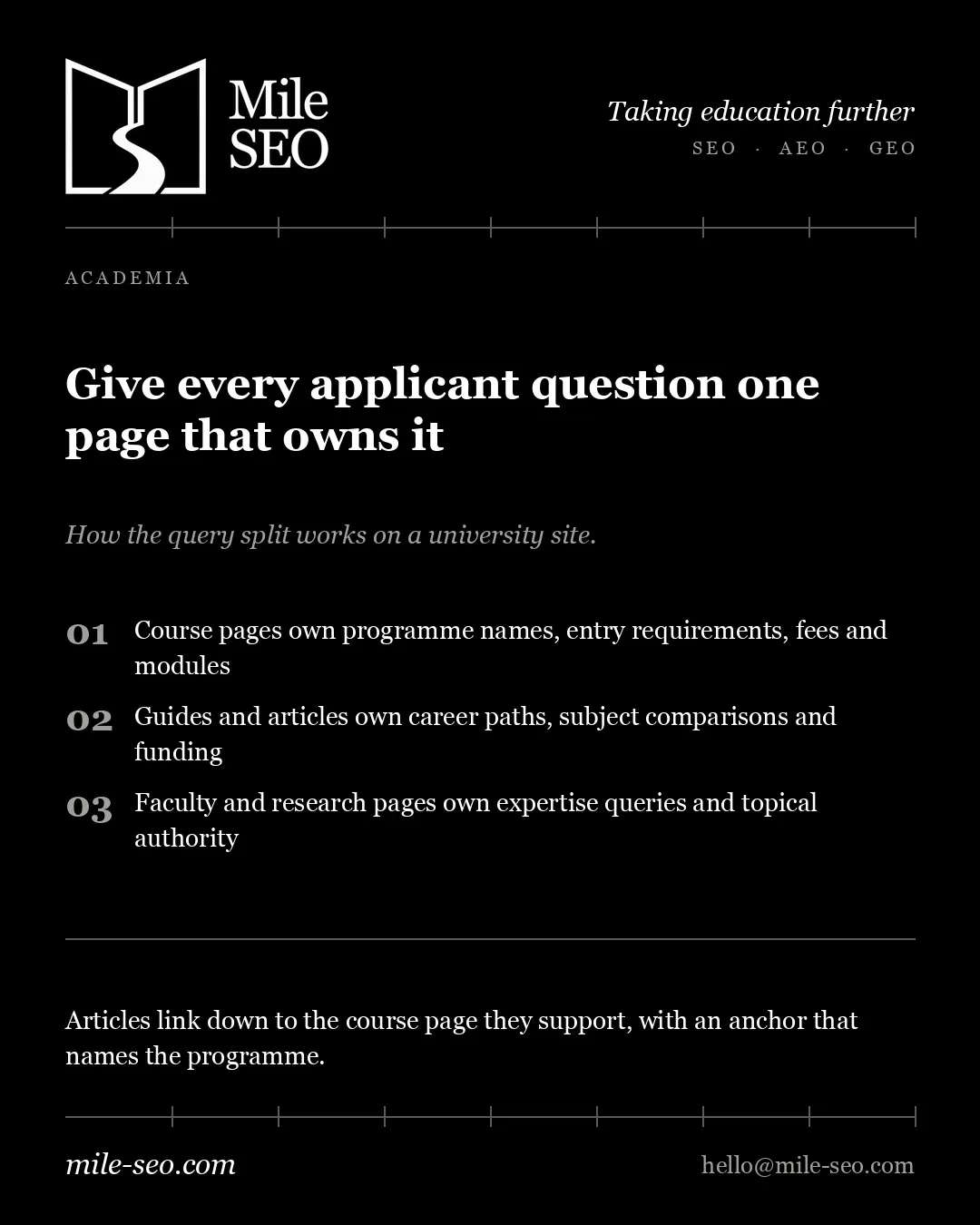
- Course pages own: programme names, entry requirements, fees and modules.
- Guides and articles own: the broader questions around the decision: career paths, subject comparisons, funding explained.
- Faculty and research pages own: expertise queries and the institution's authority on a subject.
Articles then link down into the course pages they support, with anchors that name the programme.
Before commissioning anything new, check if a page already ranks for the query.
3. Use formats that carry evidence in higher education
The formats that work in higher education carry proof a prospective student cannot get from a prospectus.
A post by a named second-year engineering student, linked to the engineering course page, answers a real question and shows what the programme is like.
The formats that consistently pull their weight:
- Decision guides that compare routes honestly (incl. when your own programme is the wrong choice).
- Student and graduate stories tied to a specific programme and outcome.
- Research explainers that turn a paper or project into something a school leaver or a journalist can follow.
Universities sit on expertise that ranks for informational queries far outside admissions, and those pages build topical authority that course pages benefit from.
The same logic drives research output visibility for research centres: the work earns attention once a page explains it in searchable language!
4. Write so AI answers can cite you
AI Overviews and AI assistants like ChatGPT, Claude, Gemini or Perplexity can now answer many applicant questions before anyone clicks.
But the content needs facts stated plainly enough to be quoted.
An answer engine can lift "The MSc takes 12 months full time and 24 months part time" from a course page. It cannot lift the same fact from a PDF prospectus or a sentence buried in brand copy.
What that means on the page:
- Put entry requirements, fees, durations and start dates in HTML text on the owning page, not in PDFs or images.
- Open guides with a direct-answer paragraph that makes sense out of context.
- Keep facts consistent across pages; a fee that differs between the course page and a blog post gives an answer engine two versions to choose from.
- Mark up courses and FAQs with structured data where it matches the visible content.
The overlap with classic SEO is large, but the emphasis moves from ranking a page to being the source a summary quotes. The distinction is laid out in how SEO, AEO and GEO differ.
5. Measure against applications, not pageviews
Judge content by numbers!
If it moves prospective students towards an enquiry, a prospectus download or an application start, it’s great!
Pageviews on a campus news story say little about recruitment…
A measurement set that works for most universities:
- Search Console query groups by decision stage, so you can see which questions you now own.
- Assisted conversions from articles to course pages, then on to enquiry or application start.
- Rankings and click-through for the course pages each article supports.
- Presence in AI answers for a fixed set of applicant prompts.
Set the baseline before publishing and review it once per admissions cycle, because recruitment seasonality distorts month-on-month comparisons.
6. Where Mile SEO helps with content marketing for higher education
Mile SEO is a search consultancy for higher education and research, built around exactly this problem: deciding which page owns which query across course pages, faculty sites and blogs.
University content marketing works when it answers the questions applicants search, gives each question one owning page, states facts plainly enough for AI answers to quote and is judged against applications.
Most of the gain comes from structure before volume.
If your content programme publishes steadily but the course pages still do not move, a 30-minute call is a good place to map where the overlap sits. The approach is set out on the SEO for universities page.
30 minutes, no charge, no deck.

FAQ
Related questions, not covered above.
- How much does content marketing for a university usually cost?
- The largest cost is internal staff time and approval rounds, not writing. A small programme of well-owned pages outperforms a large volume of loosely planned blog posts.
- Should a university outsource content marketing to an agency?
- Outsource production if you must, but keep query ownership and fact-checking in-house. Agencies write well, yet only your admissions team knows which fees, dates and requirements are current.
- How long does higher education content take to rank?
- Expect several months for new articles on an established university domain, and longer for competitive subject queries. Rewriting or merging existing pages often shows movement within weeks.
- Does social media count as content marketing for universities?
- Yes, but it plays a different role. Social posts reach people who are not searching yet; search content catches them once they start comparing programmes and asking questions.
- Do international students need separate content?
- Often, yes. Visa rules, recognised qualifications and funding differ by country, so a dedicated page per major recruitment market answers questions a single international students page cannot.