
Contents
1. What GEO means for a university?
GEO for a university is the work of getting your institution:
- named
- cited
- described
accurately when applicants ask AI about programmes, fees and fit.
The audience is already there: in EAB's survey of more than 5,000 US high school students, 46% used AI tools in their college search in autumn 2025, up from 26% that spring, and 18% removed a college from their list because of something an AI answer told them.
Google says AI Overviews and AI Mode need no special markup or new files: a page has to be indexed and eligible for a snippet, the same as before.
GEO does not replace your SEO, and the definitions are covered in our piece on SEO vs AEO vs GEO.
What changes for a university is the work list.
- It comes down to three jobs:
- knowing which questions to test
- making sure the facts are right everywhere they appear
- being present in the sources AI answers cite.
2. Build a prompt set from real applicant questions
A prompt set is a fixed list of 25 to 40 questions you run through AI assistants every month to see if your university appears, and what is said about it.
Pull the questions from places applicants already ask them: the admissions inbox, live chat logs, open day Q&A, Google Search Console queries and the subreddits for your region and subjects.
The questions applicants actually search are a better starting point than anything a marketing workshop invents.
Cover each priority programme across four question types:
- discovery: "best universities for nursing in the north of England"
- comparison: "Leeds vs Sheffield for computer science"
- facts: "entry requirements for the BSc Psychology at [university]"
- cost and outcomes: "is [university] worth it for engineering"
Run the set in ChatGPT, Gemini, Perplexity, Copilot etc. (note: logged out where you can). For each answer, record three things:
- are you mentioned?
- are pages of yours cited?
- are the facts stated correct?
3. Check crawler access for good GEO
AI tools can only cite pages their crawlers can reach!
University sites often block them by accident, through a bot-protection setting at the CDN or a blanket robots.txt rule written to stop model training.
Blocking OpenAI's GPTBot keeps your content out of model training, but blocking OAI-SearchBot keeps your pages out of ChatGPT's cited sources.
Check each crawler separately, and check the firewall logs, not only robots.txt.
Referral traffic will stay small for a while. The prompt set is the measure that shows if applicants are hearing the right things about you.
4. University citation for GEO
Your citation surface is every page an AI answer could cite when it talks about you.
This is why off-page SEO is really important for every website!
Rankings, course aggregators, Wikipedia, Reddit threads, student review sites and news coverage all feed answers to discovery and comparison prompts, often ahead of the university's own pages.
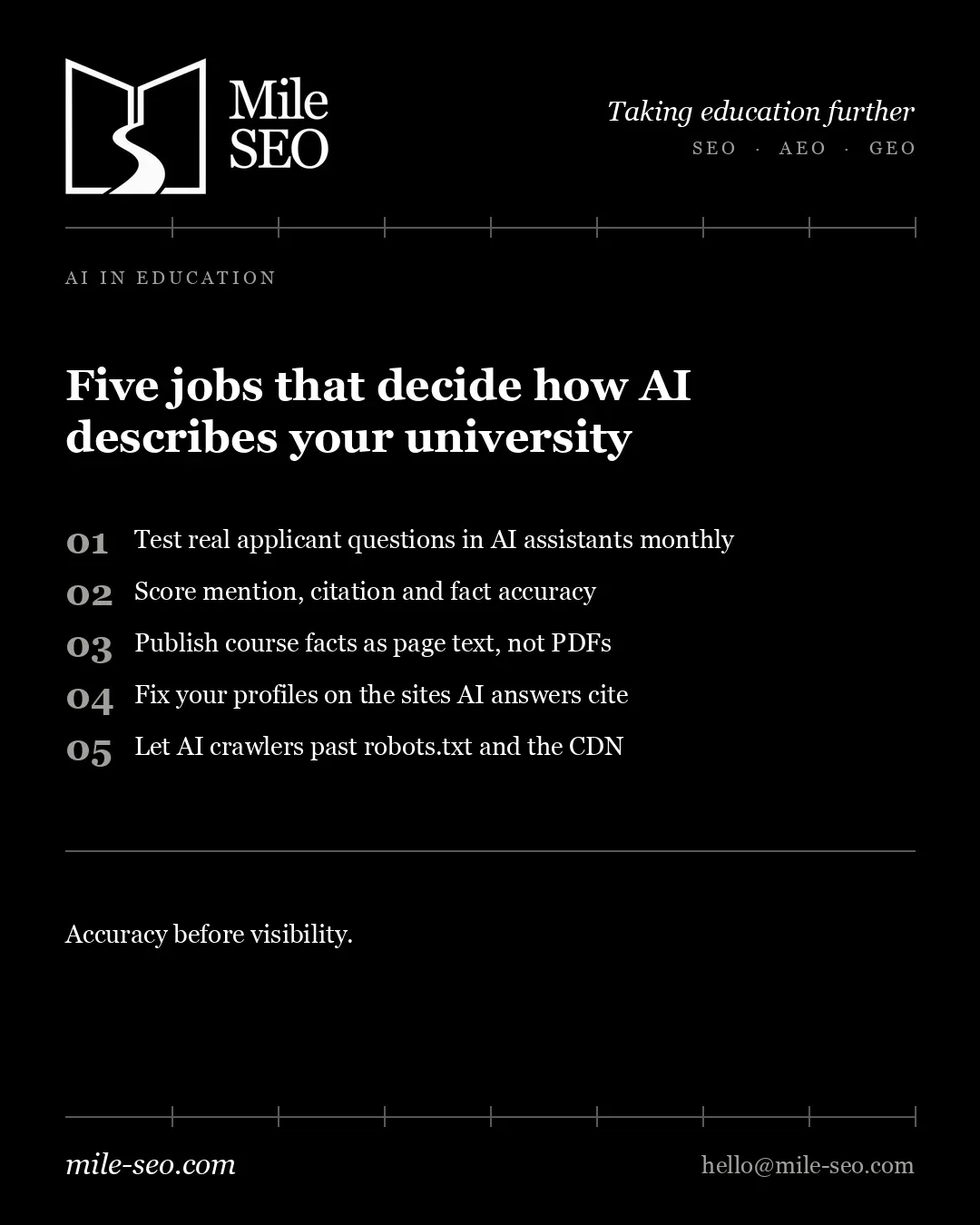
Your prompt runs show which of these sources are cited for your programmes. Work on those first:
- correct your profiles on the aggregators and ranking sites that keep appearing
- fix factual errors in your Wikipedia article by proposing them on its talk page, as Wikipedia's conflict-of-interest guideline asks
- put academics forward as named experts in press coverage of their field
- publish research news on pages with crawlable text, not only as PDFs or social posts
The last two are where research visibility and student recruitment overlap. A faculty that makes its research findable also gives AI answers a reason to name the university when applicants ask who is strong in a subject.
5. Mile SEO’s GEO for universities
Mile SEO is a search consultancy for education, and higher education is one of its three focus areas: course page structure, programme finders, and the AI answers applicants now read before they reach your site. It is run by an SEO manager who is also a doctoral researcher, so the proof is in published research and public teardowns.
GEO for a university is mostly disciplined SEO with a new feedback loop.
If you want to see where your programmes stand in AI answers today, a 30-minute call is a good place to start:
30 minutes, no charge, no deck.

FAQ
Related questions, not covered above.
- How long does GEO take to show results for a university?
- Changes to your own pages show once AI crawlers recrawl them, often within weeks. Third-party profiles and press coverage move slower, so judge GEO over a full admissions cycle.
- Should a university write content specifically for AI chatbots?
- No. Pages written for chatbots rather than applicants read badly and give answers little worth citing. Clear course pages with plainly stated facts serve both audiences at once.
- Is an llms.txt file worth adding to a university website?
- Google says its AI features need no new files such as llms.txt. Adding one costs little, but it cannot fix a course page that hides fees in a PDF.