
Contents
- Enrollment stats: measure applications, not sessions
- Target the queries closest to an application
- Make each program page the only answer to its query
- Find where your own pages compete for the same program
- Get your program facts into AI answers
- What changes for private K-12 schools
- How Mile SEO helps with enrollment growth
1. Enrollment stats: measure applications, not sessions
SEO for enrollment growth is judged by one number: how many inquiries, applications and deposits started with an organic search visit.
Sessions and rankings are only inputs.
An institution can double its blog traffic and enroll no one extra, because most of that traffic lands on articles read by people who will never apply. You don’t want that.
Set the measurement up before touching content!
Track the request-for-information and apply-start forms as GA4 key events, pass the landing page and source into the CRM admissions uses (Slate, Salesforce Education Cloud or similar), and report organic-sourced inquiries by program.
2. Target the queries closest to an application
The queries that produce enrollments name a program and add a qualifier:
- "online MSN programs Texas"
- "part-time MBA cost"
- "BSW no GRE"
- "nursing program application deadline".
Volumes are usually small, and that is fine. (Someone typing a delivery format, a price question or an entry requirement is already comparing providers.)
Build the keyword list per program rather than per institution, using the modifiers prospective students actually add:
- the program name in the form students use (MSN, not the full formal title)
- format and location: online, hybrid, evening, near me, a state or city
- decision questions: cost, tuition, requirements, deadline, accreditation, transfer credits
- outcomes: salary, licensure, jobs after graduating
Generic "how to choose a college" content sits at the other end. It draws traffic, rarely converts, and competes with every institution in the country. Keep it to a minimum until the program-level queries are covered.
3. Make each program page the only answer to its query
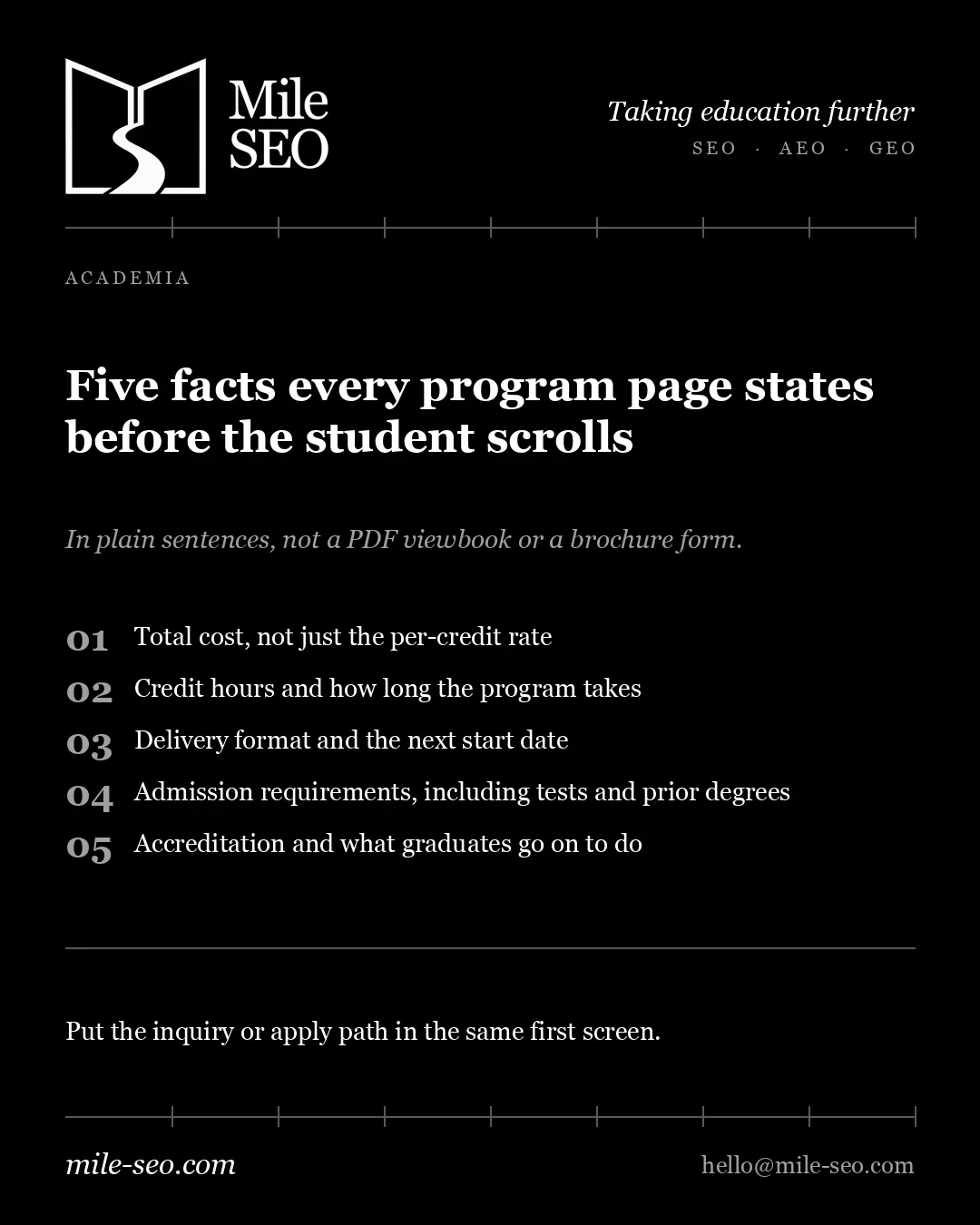
A program page ranks and converts when it answers the decision questions on the page itself:
- total cost
- credit hours
- length
- start dates
- delivery format
- admission requirements
- accreditation
- what graduates go on to do.
Pages that bury those facts in a PDF viewbook or behind a "download our brochure" form lose to pages that state them.
Order matters as well!
Put the key facts and the inquiry or apply path in the first screen, then curriculum, faculty and outcomes.
Plenty of university program pages open with a mission paragraph and a hero image, and the student scrolls past both looking for tuition.
Then add an FAQ block for the program's real objections, such as "Can I work full time during this program?" or "Do I need clinical placements in my state?"
Note: Admissions counselors hear these every week. Ask them for the 10 most common and answer those in plain sentences on the page.
4. Find where your own pages compete for the same program
Cannibalization (meaning two or more of your URLs competing for one query) is the most common reason a solid program page stalls on page two.
At a typical university the same program appears on the program page, the department page, the academic catalog, a PDF viewbook, the online division's microsite and sometimes an online program manager's landing page.
Google only picks one (and often the wrong one) and keeps switching time after time.
The fix is one owner per query.
The catalog stays for the registrar and links to the program page, the department page summarizes and links, and duplicate microsite pages redirect.
5. Get your program facts into AI answers
Google shows an AI Overview above the organic results for many enrollment queries, and prospective students now ask ChatGPT and Perplexity to shortlist programs for them.
Those answers cite pages that state facts plainly.
Aggregators (US News, Niche and BestColleges) get cited because they publish tuition, format and accreditation in consistent sentences, while many institutions put the same facts in images, tabs and PDFs.
Three changes make your own page the likelier source:
- State each key fact in a full sentence as well as in the table, for example "The online MSN costs $28,500 in total and takes 24 months part time."
- Keep those numbers identical across the program page, the catalog and third-party listings, because conflicting figures push an engine toward the aggregator.
- Mark the page up with the schema.org EducationalOccupationalProgram or Course type so the facts are machine-readable.
(The difference between ranking, being the answer and being cited is set out in SEO vs AEO vs GEO.)
6. What changes for private K-12 schools
The same logic drives private K-12 school enrollment growth, with a parent as the searcher and a local map pack above the results.
Parents type:
- "private schools near me"
- "independent school tuition" plus a city
- "Montessori kindergarten" plus a neighborhood
- "boarding schools with financial aid".
And even then. the Google Business Profile often gets the click before the website does.
Schools that publish tuition and financial aid openly have an edge in comparison searches, since parents screen on cost before they book a visit.
The detail for independent schools is on the SEO for private schools page.
7. How Mile SEO helps with enrollment growth
Mile SEO is a search consultancy for education, and enrollment-led SEO for colleges and universities is a large part of the work: finding which program pages compete with each other, which facts AI answers cannot extract, and which organic inquiries never reach the CRM.
Measure organic enrollment by program, target the searches that pair a program with a decision, give each program one page that states its facts in plain sentences, and make sure nothing else on the domain competes with it.
If your program pages rank but inquiries stay flat, the gap is usually visible in one audit.
A 30-minute call is enough to tell whether that applies to you…
30 minutes, no charge, no deck.

FAQ
Related questions, not covered above.
- How long does SEO take to affect enrollment?
- Program page rankings often move within three to six months, but enrollment follows the admissions cycle, so judge inquiries and applications over one full cycle before drawing conclusions.
- Should we cut paid search once organic search grows?
- Not across the board. Lower bids where the program page already ranks first organically, and keep paid coverage for new programs, crowded markets and the weeks before deadlines.
- Does an online program manager affect our SEO?
- It can. If the OPM runs its own landing pages for your programs, those pages may compete with yours. Agree in the contract which domain owns each program query.
- Can we measure enrollment that comes from ChatGPT or Perplexity?
- Partly. Visits from chatgpt.com and perplexity.ai appear in GA4 as referrals, but most AI influence leaves no click, so add a self-reported source question to the inquiry form.
- Is a blog worth it for a university enrollment strategy?
- Yes, once the program pages are fixed. Articles on careers, salaries and licensure catch earlier research, and each should link to the matching program page rather than the homepage.