
Contents
1. SEO vs AEO vs GEO: explained as a university library
Picture a university library with three ways a book reaches a reader:
- SEO gets it catalogued and shelved
- AEO gets a passage read out at the reference desk
- GEO gets it cited in someone else's literature review.
SEO: The Catalogue
A catalogue search returns a ranked list of records; the reader picks one and walks to the shelf.
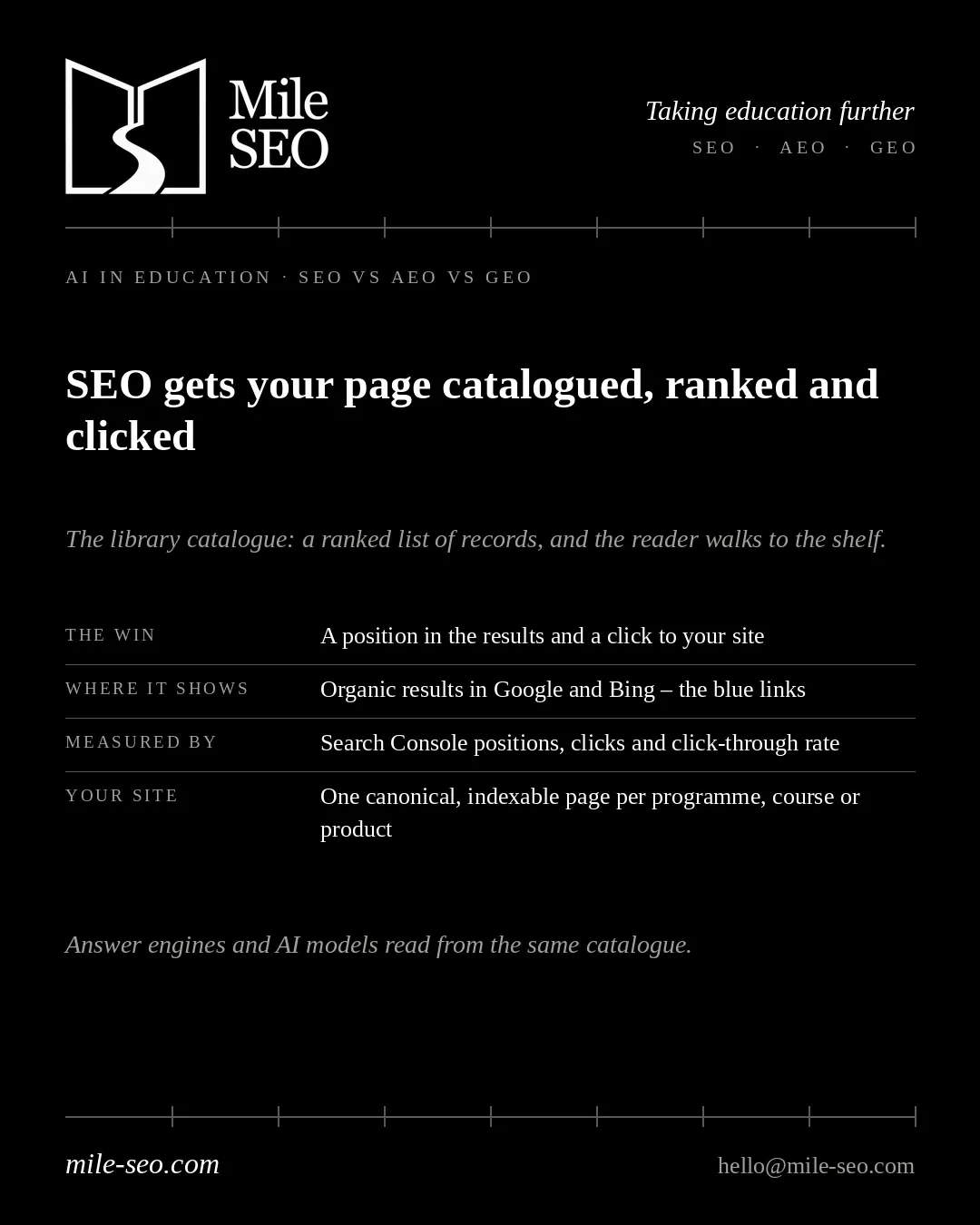
Search engine optimization is the same transaction:
an indexed page → a position against competing pages → a click.
A book with the wrong shelfmark never gets borrowed, which is why library catalogue indexing behaves like any other search problem.
AEO: The Reference Desk
Someone asks the librarian a question, and the librarian reads out one paragraph from one book.
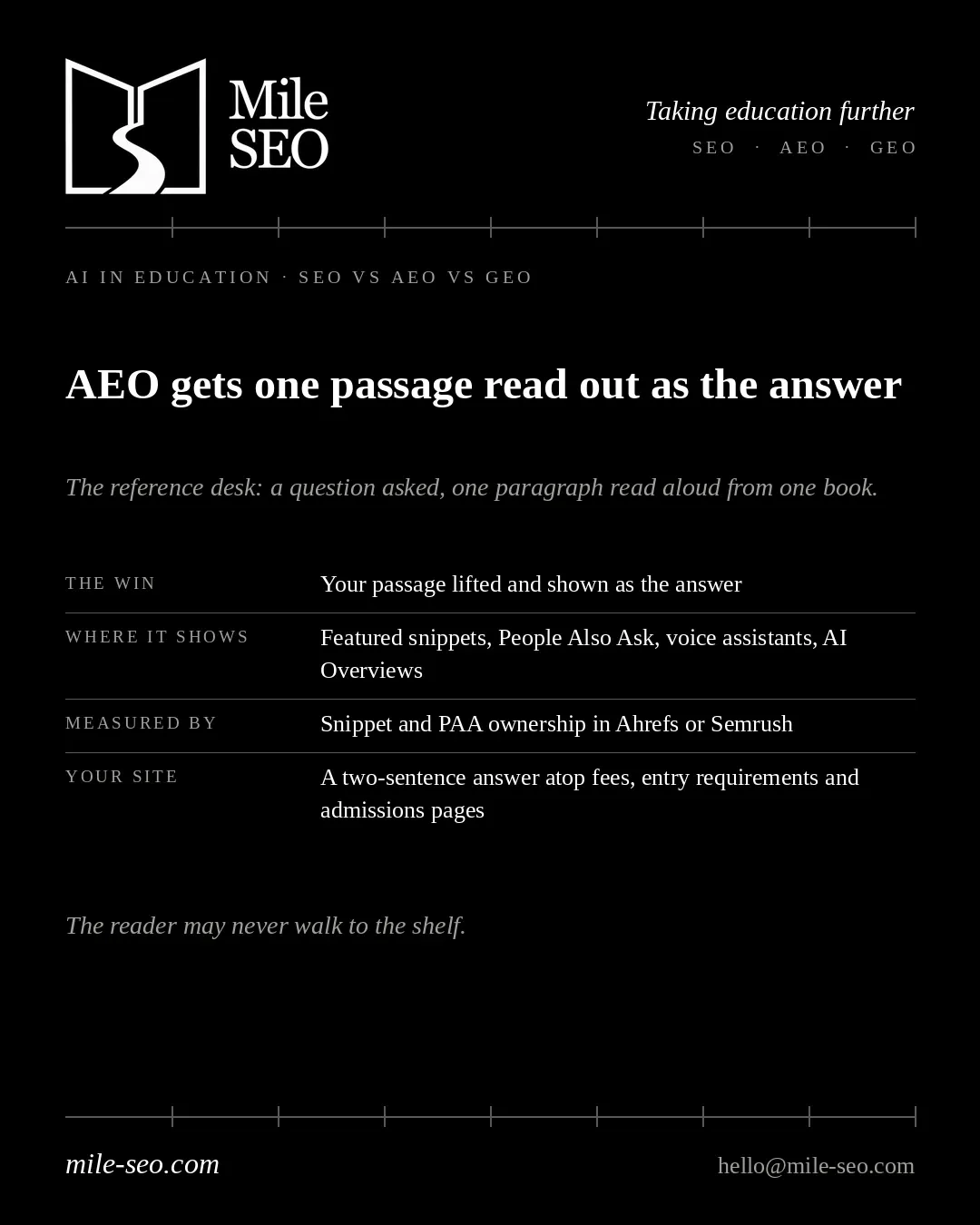
Answer engine optimization targets that moment: featured snippets, People Also Ask boxes, voice assistants and AI Overviews, where a single passage is lifted and shown as the answer.
The reader may never visit the shelf.
GEO: The Literature Review
A research assistant reads twenty sources and writes a synthesis with a short bibliography.
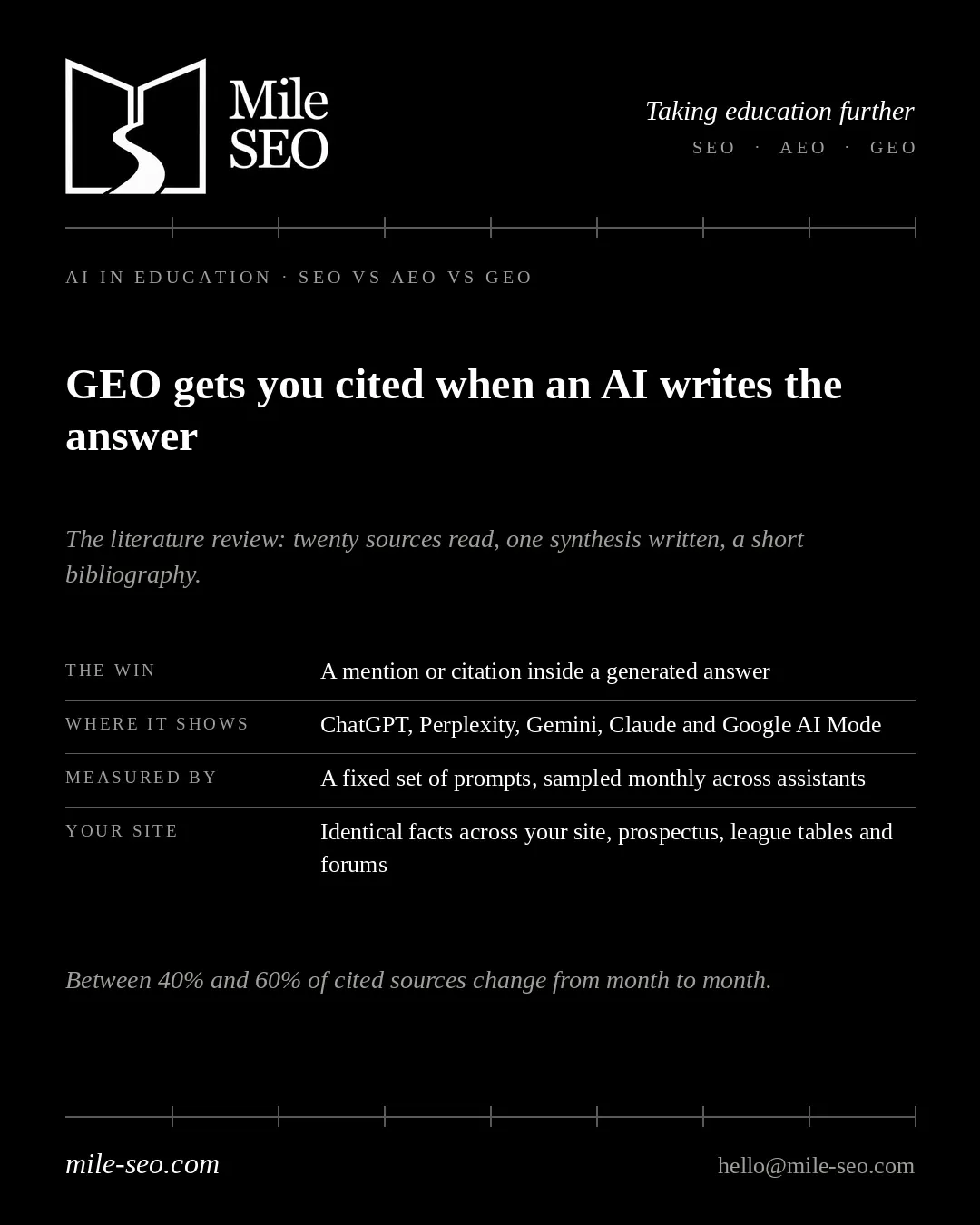
Generative engine optimization is about making that bibliography when ChatGPT, Perplexity, Gemini or Claude compose an answer.
2. Where the SEO, AEO & GEO differ: what counts as a win
SEO wins a position and a click, AEO wins the extraction of one passage, and GEO wins inclusion (and an accurate description) inside a generated answer.
All of this structuring also changes what you can measure.
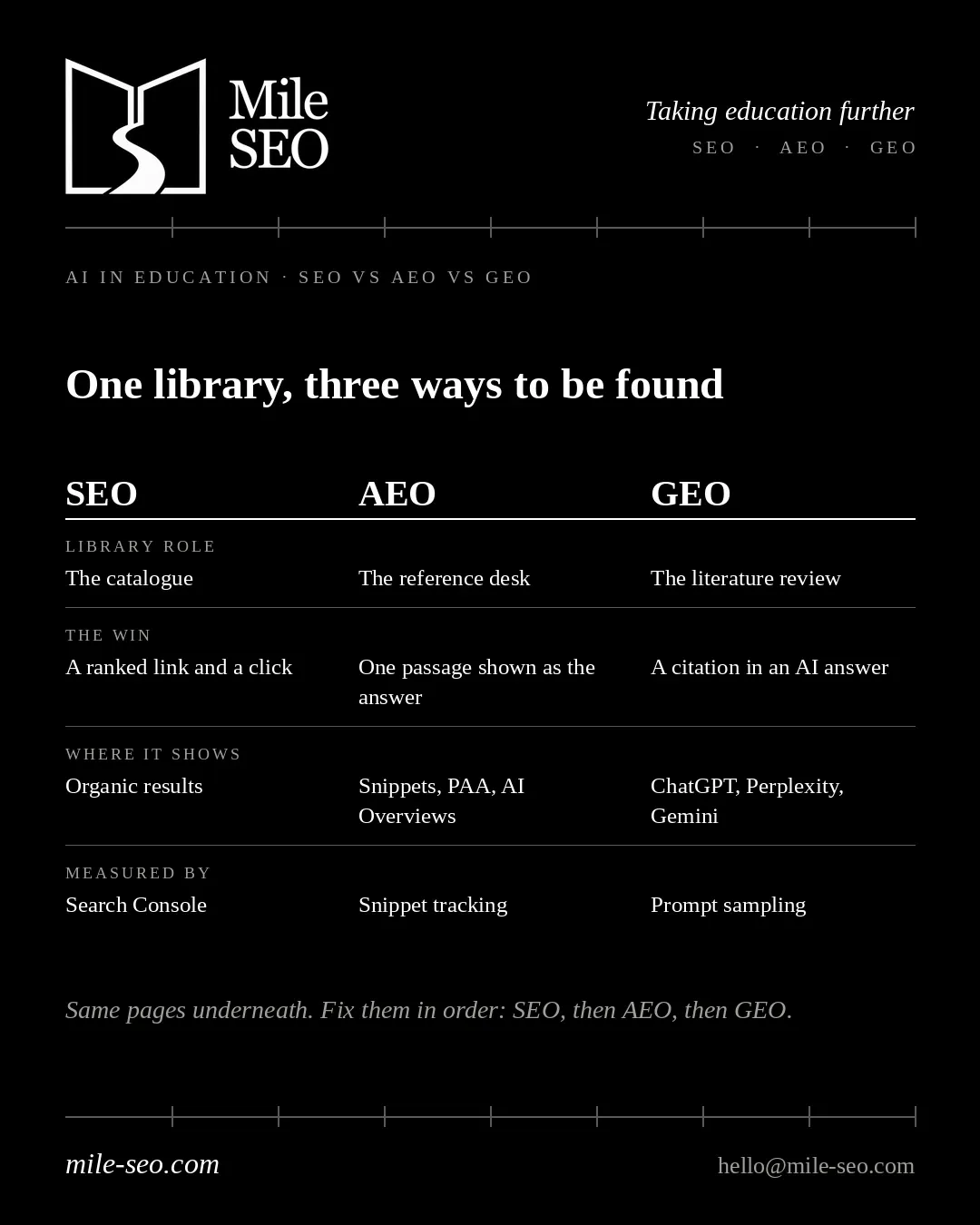
SEO has mature instrumentation: Search Console positions, clicks and click-through rate.
AEO is half-visible. Ahrefs and Semrush track snippet and People Also Ask ownership, but Search Console folds AI Overview appearances into ordinary web search data.
GEO is the weakest (right now). The same prompt produces different answers, and between 40% and 60% of cited sources change month to month across Google AI Mode and ChatGPT. Bing's AI Performance report in Webmaster Tools is one of the few first-party reports so far.
Being cited does not mean being visited, either. Similarweb's 2026 GenAI Brand Visibility Index found Reuters and The Guardian get under 1% of their referral traffic from AI platforms, despite being cited often.
In library terms, SEO counts loans, AEO counts how often the desk reads from your book, and GEO counts bibliography entries in reviews you rarely get to see.
Note: This question is live enough that multiple Reddit threads asking someone to explain GEO and AEO hold the first few organic positions for these keyword variations, above every agency guide.
3. What SEO, AEO & GEO asks of an education website?
Each asks for different work on the same pages:
- SEO: one canonical, indexable page per programme, course or product. Course finders, PDF prospectuses and faculty copies that spin up duplicate URLs split the signal before AEO or GEO get a look.
- AEO: a standalone two-sentence answer at the top of fees, entry requirements, term dates and admissions pages, plus FAQs phrased the way parents and applicants actually ask.
- GEO: identical facts (fees, accreditation, intake dates, programme length) across your site, prospectus, league-table profiles, Wikipedia entry and aggregators, and a presence in the forums applicants use. For edtech platforms and learning apps, that means comparison threads and review sites as much as your own blog.
4. Which optimization to work on first?
SEO first, AEO second, GEO third, because each draws on the one before it.
The reference desk and the reviewer both work from the catalogue, and a course page that is not indexed cannot be read aloud or cited.
AEO is the cheapest second step.
It is mostly just rewriting page openings, and snippet ownership shows up in tools you already pay for. GEO is the slowest and the least certain, so start small: a fixed set of 20–30 questions your applicants ask, checked monthly across two or three assistants, with changes made off-site as well as on it.
There is one exception. If your audience already asks ChatGPT which language app or revision platform to use, GEO moves up the list, because that is where the shortlist gets made. A staged, audit-first approach keeps the order honest either way.
5. Where Mile SEO helps you with SEO vs AEO vs GEO decision
Mile SEO is a search consultancy for education that treats SEO, AEO and GEO as one visibility problem across universities, libraries, schools and learning products.
The three acronyms describe one library with three desks.
If you want to see which of your course pages are catalogued properly, which get read at the desk and which make the bibliography, a 30-minute call is the easiest place to start. The page on SEO for higher education sets out how that work usually runs.
30 minutes, no charge, no deck.

FAQ
Related questions, not covered above.
- Is AIO the same as AEO or GEO?
- Some people use AIO for Google's AI Overviews, others for AI optimisation across every AI system.
- Does schema markup help with GEO?
- Schema makes facts machine-readable and helps search engines interpret a page, which supports AEO directly. Evidence that it changes language model citations is thinner.
- Should a university block AI crawlers in robots.txt?
- Only selectively. OpenAI, for example, runs GPTBot for model training and OAI-SearchBot for search answers. Blocking the search crawler removes you from ChatGPT's cited sources, which few institutions want.
- Do we need an llms.txt file?
- llms.txt is a proposed plain-text file listing a site's key pages for language models. Support from the major AI providers remains unconfirmed for now.
- Can a small school compete with large universities in AI answers?
- Answers about one town, one programme or one entry route can draw on whichever source states those facts clearly, and large institutions rarely cover local detail well.