

Higher Education SEO Checklist
For university and college web, marketing and admissions teams.
The problem
University websites rarely fail on one big problem. They fail on ownership: dozens of subdomains, faculties competing for the same course searches, fee tables that live on in old PDFs, and portals and aggregators that outrank the programme page.
This checklist is written for the teams who fix that, section by section.
What’s inside
- 01Foundations and governance
- 02Subdomains and microsites
- 03Query ownership and cannibalisation
- 04Programme pages
- 05Admissions, fees and funding
- 06International students and languages
- 07Research and staff pages
- 08Technical health
- 09Structured data
- 10Your facts beyond your own site
- 11AI answers
- 12Content lifecycle
Regional modulesUnited States · United Kingdom · EU and elsewhere
Three items, as they appear in the checklist
- 03.1
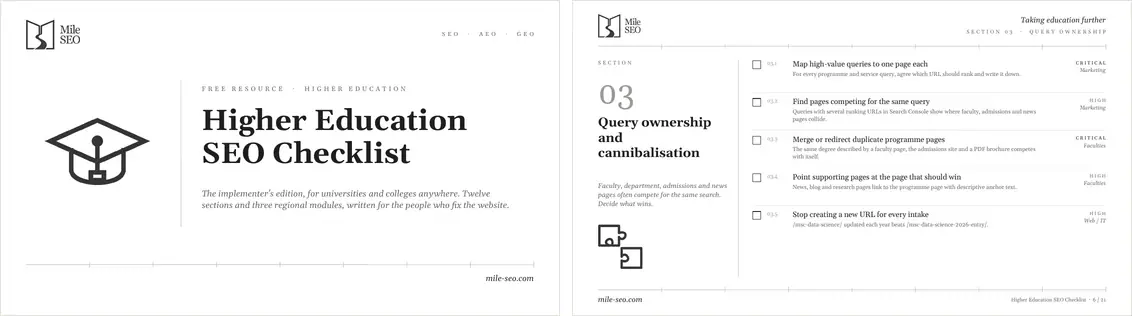
Map high-value queries to one page each
For every programme and service query, agree which URL should rank and write it down.
- 04.2
Put the key facts in the page text
Fees, duration, study mode, start dates, entry requirements and deadlines. Not only in a PDF or an image.
- 10.1
Keep application portal listings accurate
UCAS, Common App and national admission portals are often the first result for a course.
Get the checklist
Free. Tell us who you are, and the download link appears right here.
Frequently asked questions
- Should old course pages be deleted?
- Rarely. Redirect a closed course to its nearest successor, or keep it with a clear notice while people still search for it. Deleting it throws away its links.
- Do subdomains hurt a university’s search visibility?
- Not by themselves. The damage comes from duplicated, outdated or forgotten subdomains that split authority and confuse searchers. Keep the ones with a clear purpose and fold in the rest.
- Where do AI assistants get their facts about universities?
- From your own site, admissions portals, Wikipedia, rankings and review sites. Consistent facts across those sources make accurate answers far more likely.