
Contents
- Why aggregators outrank universities for scholarship searches
- Give every institutional award its own indexable page
- Build hub pages around how applicants actually search
- Treat the outside scholarships page as the link target it is
- Keep award URLs stable across admissions cycles
- Make award facts easy for AI answers to extract
- How Mile SEO helps with university scholarship pages
1. Why aggregators outrank universities for scholarship searches
Aggregators outrank universities because they publish one indexable page for every way a student searches.
Most universities publish one page for everything.
A query like "best scholarships in the US" or "engineering scholarships for international students" lands on a scholarship aggregator, a publisher's scholarship finder or a list post.
The aggregator model is not complicated…
Each award gets:
- its own URL with the amount,
- deadline and
- eligibility
written into the HTML.
Hub pages slice the database by:
- subject,
- state,
- applicant type and
- deadline.
These sites run like any other content-led educational website: one page per query, heavily interlinked, refreshed every cycle.
The typical university scholarships section does the opposite.
Awards sit in a single long table, in a PDF for the current academic year, or inside a scholarship management platform that needs a student login.
Search engines cannot rank what they cannot crawl!
Some finders even list the university's own awards, so the institution supplies the content and someone else collects the visibility.
2. Give every institutional award its own indexable page
The fix is one crawlable URL per award, or per tightly related family of awards, with the core facts written into the page, and not attached as a document.
That page can rank for the award name, and it becomes the source an aggregator or an AI answer ought to cite.
Each award page needs the same set of facts, near the top and in the same order every time:
- the amount, and if it is one-off or renewable
- who is eligible, by programme, level, residency or circumstance
- if it is awarded automatically on admission or needs a separate application
- the deadline and the academic year it applies to
- the funder, whether that is the university, a named donor or an endowment
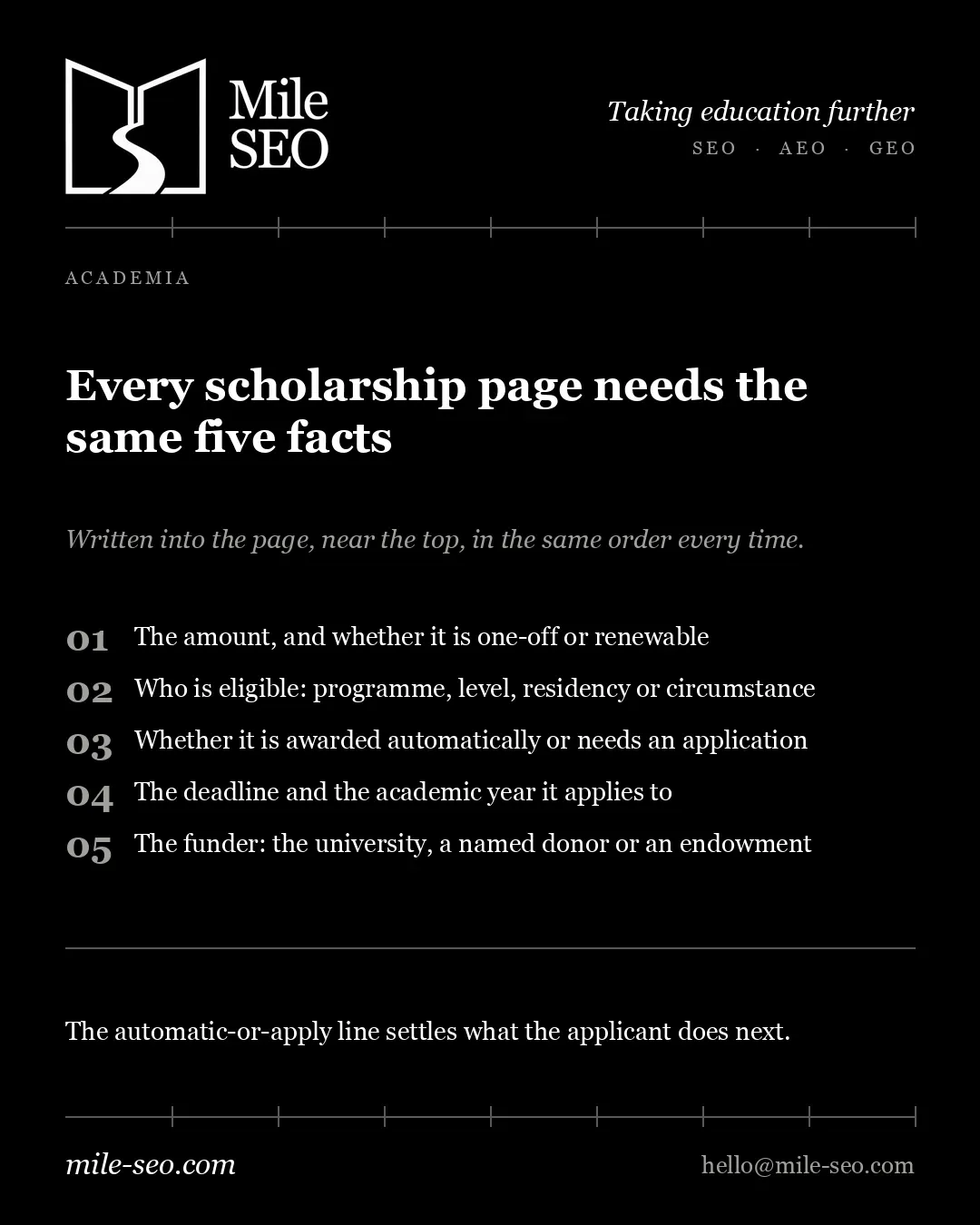
The automatic-or-apply line deserves its prominence. It is the first thing an applicant wants settled, and it decides what they do next.
If awards are managed in a scholarship platform, keep the application workflow there and publish the description on the main site.
The platform can handle the process. The public page should carry the search visibility.
3. Build hub pages around how applicants actually search
Applicants search by who they are and what they want to study, so the hubs above the award pages should follow those two lines.
A single scholarships landing page cannot rank for "scholarships for international students" and "nursing scholarships" at once.
Two different hub pages can.
Hub page by applicant type
International, first-generation, transfer, mature and postgraduate research applicants tend to put their status into the query.
Give each group a hub that lists the awards open to it, with a short opening that answers the eligibility questions specific to that group.
Hub page by programme or faculty
Subject hubs pick up searches like "engineering scholarships at [university]".
They also give faculty sites something better to link to than the central funding office homepage.
Every course page should link to the awards its applicants can hold, because the course page is where most applicants already are, and it passes internal authority to the pages that need it.
4. Treat the outside scholarships page as the link target it is
A university's list of external scholarships is one of the most solicited pages on its site, because agencies sell scholarship link building to their clients.
A company funds a small award, emails financial aid offices asking to be listed, and hopes for a backlink from a high-authority domain.
Guides to the tactic openly recommend a site:.edu search to find the pages to pitch.
Google has been blunt about how much this is worth. In 2018 John Mueller said that because .edu links are wrongly treated as more valuable, those sites attract link spam, and Google ignores many of the links on them.
The sponsor gains little, and the page gains nothing from a list of off-topic companies offering thin awards.
So, instead, set minimum criteria for external awards, check that each one exists and was actually awarded last cycle, mark the outbound links rel="nofollow", and review the whole list once a year.
The same issue turns up on high school counselling pages that list outside scholarships for pupils heading to university.
5. Keep award URLs stable across admissions cycles
A scholarship page should keep the same URL year after year, with dates and amounts updated in place.
Publishing a fresh page for each academic year throws away whatever the old page had earned in links and rankings, and it can leave last year's version ranking with an expired deadline.
The pattern is familiar: /scholarships-2025-26/, then /scholarships-2026-27/, with the old page never redirected!
Applicants land on the expired version, find a closed deadline and leave, while an aggregator with a current copy takes the click.
Put the academic year in the page content and the title tag, never in the URL.
When an award is discontinued, redirect its page to the nearest hub instead of deleting it.
When a donor renames an award, redirect the old URL to the new one.
A visible "last reviewed" date helps too, provided the review is tied to a fixed point in the admissions cycle rather than left until someone notices.
6. Make award facts easy for AI answers to extract
AI Overviews and AI assistants answer scholarship questions by pulling facts from pages they can parse.
A labelled amount, eligibility line and deadline in plain HTML is far easier to extract than the same facts in a PDF or buried mid-paragraph.
Two habits make the difference:
- Write each fact as a complete statement that survives being lifted out of context: "The award is worth £3,000 a year for up to three years" works, "worth up to £3k (see terms)" does not.
- Answer the obvious follow-up questions on the page itself (e.g. can the award be combined with other funding?).
Structured data is optional here.
Schema.org does have a MonetaryGrant type with amount and funder properties, but it sits in the vocabulary's "new" area and Google offers no scholarship rich result.
7. How Mile SEO helps with university scholarship pages
Mile SEO is a search consultancy for universities and research institutions, built around problems like this one, where the right page should exist but a third party answers the query.
If your scholarships section is currently a PDF, a login wall or one long table, a 30-minute call is usually enough to decide which awards to rebuild first. The page on how Mile SEO works with universities sets out how that work tends to run.
30 minutes, no charge, no deck.

FAQ
Related questions, not covered above.
- Should the scholarships section sit under admissions or under fees and funding?
- Link to it from admissions and course pages, where applicants look while deciding, wherever the section lives. Internal links matter more than folder location.
- Is it worth getting university awards listed on scholarship aggregators?
- Yes, provided each listing links back to the award's own page on your site. That keeps the university the canonical source, not one entry in someone else's database.
- Can small donor-named awards rank if nobody searches for them by name?
- Rarely on their own, and that is fine. Their value comes through the hubs, where they add depth to pages targeting broader searches such as subject or applicant-type scholarships.
- Do international scholarship pages need translating for overseas applicants?
- Only where the university recruits in that language. Translated pages need hreflang annotations and the same fact block, and must be updated alongside the English version.
- Who should own the scholarships section, the funding office or the web team?
- The funding office should own the facts and review date; the web team should own templates, URLs and redirects. That split stops pages going stale between admissions cycles.